Into The Unknown

Knowing where God wants us to go or what he wants us to do is one thing – actually doing it is another! The people of Israel knew that God was leading them into the Promised Land but they doubted that they had the ability to get there. Moses knew God was sending him to Pharaoh but he thought he lacked the strength. Jeremiah thought he was too young, Amos was unqualified, and Peter and John were uneducated. Have you ever had the conviction and even the opportunities to engage in some task or project, believing it is of God, but were reluctant to take it on because of lack of strength or resource? Have you ever walked to the edge of the river, as did the people of Israel, looked over at the other side but then gone back to the wilderness because you lacked the courage or strength to go across?

As we go through life we are continually confronted with opportunities to move with God. He tells us in Jeremiah 29 that he knows the plans he has for us, plans for welfare, a future and hope, but the responsibility is still ours to implement these plans. They won’t ‘just happen’. Where do we get the necessary resources and strength? In Isaiah 40:28-31 God gives us our first clue – our strength comes from waiting on him. Isaiah 31:15 tell us that it is in repentance and rest that that we will be saved and in quietness and trust is our strength. But he adds ‘but you were not willing’.

Before we wait on God for strength and courage, we must first be willing to do whatever it is he leads us to. As the people of Israel prepared themselves to finally go into the Promised Land, they waited on God for three days. They were ready and willing and now they waited in the presence of God. It is in the waiting and depending on him that God provides the strength. They didn’t run ahead of God – they had tried that before and failed. They listened to him, and they waited. Sometimes waiting is the most difficult part. It is easier to do something, anything, than it is to wait. And yet this is God’s way. After his anointing by the Holy Spirit, Jesus was led into the wilderness to wait. After the resurrection the disciples were told to stay in Jerusalem and wait. Having heard from God we need to wait.

After the people of Israel had waited before the Lord they consecrated themselves. Not only did they need to wait on God but they needed to prepare themselves to do God’s business God’s way. The act of consecration is the setting apart of the whole life – not just part of it. They needed to be completely set apart before they took on the Lord’s mission – then they went. They had heard from God, they had waited for his timing and they had prepared themselves – now they needed to obey. It was not until they showed their faith by obedience that God prepared the way. When their feet were in the river, he made a path for them to cross. They didn’t wait for circumstances to change they acted believing that they would.

If God has called you, and he has, you may want to know where he is calling you to, unlike Abraham who ‘went out, not knowing where he was going’ (Hebrews 11:9) – but when he tells you to move, then move. Once over the river the people of Israel were told to set up a stone monument as a reminder of where God had brought them from and where he was taking them. This was a step of commitment; there was no going back. God wants to know that we are committed to the task he calls us to before he will make available his limitless supply of resources.

Wait before the Lord until he shows you his plans and his timing. Consecrate yourselves to him and take the first step of obedience. Then commit yourselves to continuing in his will no matter what the circumstances being certain that he that began a good work in you can and will bring it to completion. (Ph 1:6).

What makes a significant woman?

Psalm 139:13-18

Significance can be described as a quality or character that should mark something as important but is not obvious and may or may not be recognized by others. The English word ‘significance’ does not appear in the bible and the nearest to it ‘signification’ is only used negatively to mean that something ‘without signification’ cannot be understood. The idea of signification is to make known or clear, often using words or signs. Words such as important, powerful meaningful or remarkable which can be similes of significant may be found and the context will determine their meaning. So what is the idea of a woman who is significant meant to suggest?

The women mentioned in this series have had an important role in God’s eternal plan of redemption. They may not have been aware of the part they played and they may have been ignorant of the effect it would have. Some of these women are not well known while others are what might be called Biblical celebrities! Some are obvious such as Eve or Mary the mother of Jesus while many are more obscure like Damaris or Susannah. Some women intended their actions for good while others like Potiphar’s wife had the opposite intent, some acted entirely out of self interest while there were those whose desire was to serve others. They were not significant because of the their personal agenda or characteristics but because God worked in and through them to bring about the plans and purposes he had for the redemption of the world.

The Contemporary English Bible puts 1 Corinthians 1:26-27 this way: ‘My dear friends, remember what you were when God chose you. The people of this world didn’t think that many of you were wise. Only a few of you were in places of power, and not many of you came from important families. But God chose the foolish things of this world to put the wise to shame. He chose the weak things of this world to put the powerful to shame.’ These thoughts are reflected in the women that God chose to be significant. That is not to say that there were not those who were wise, or in places of power and influence, or from important families, but this is not what made them significant.

Some of these significant women were married, while others were divorced, widowed or single; some were old, like Elizabeth and Anna while there were children like Miriam, who was later significant as an adult and young teenagers like Mary, the mother of Jesus and Rachel and Rebecca. There were business women including Lydia and Priscilla, women of high social standing and those of dubious backgrounds (Rahab, Mary Magdalane and the woman of Samaria). There were servants (Rhoda, Hagar) and independent and wealthy supporters of Jesus and the apostles. They were called wives, mothers, grandmothers and sisters, prophets, apostles, deacons and disciples, some were poor and oppressed while others rich and powerful. Each one was made in the image of God, chosen and set apart by him and recorded in his word as an example and encouragement for our sake.

As we read the stories of the Bible and see the characters who appear there, we can see the hand of God actively encouraging and guiding each one so that the way is prepared first of all for the coming of his son, and then the building of his church. Even now he is guiding and encouraging ordinary men and women into places of significance where their words and actions will be important in determining the future of not just their families and friends but the world beyond them, for eternities sake.

  1. Do you feel significant?
  2. How often do we look at ‘celebrities’ as our examples?
  3. Who have been the significant people in your life?

Join the Revolution

The Beatles song of 1968 posed the question “so, you say you want a revolution? Well you know, we all want to change the world”. The history of the world could be written in terms of wars, revolts and revolutions. While recent literature (especially that written in the USA) argues that the first revolution was the American Revolution of the late 18th Century and that of course, in their view was the most important, revolutions have been around much longer than that. The first recorded in history was in Egypt over 2500 years before the birth of Jesus, which is probably about 500 years before Abraham! There has probably never been a year since, when there has not been a conflict of ideas, or ownership of resources somewhere in the world since.

Political revolution usually occurs when one group of people feel they are being unfairly treated or oppressed by the ruling class. Often, but not always it results in violent action and the emergence of a new ruling elite. There are other revolutions as well, of ideas, values and even the means of production. Change usually meets resistance and the fear of losing something of value and conflict can result. History is filled with the names of revolutionary leaders, some wanted power, others had new ideas in science or politics, there were those who campaigned for individual rights and protections and some wanted a greater distribution of wealth. It seems that John Lennon was right, everybody wants to change the world – in some way.

Jesus emerged on the shores of the Sea of Galilee with a call to revolution. The Jews, who were oppressed by the Romans, saw him as the deliverer they had waited for. Some of his followers were already heavily involved in a rebellious group called Zealots. They didn’t want equality for everyone though, they just wanted to regain their position as rulers, not servants. They were comfortable with people being oppressed, as long as it wasn’t them. Jesus quickly gathered a following, his hearers were anxious for him to outline how things would be restored; so, when he sat down on the hillside to explain what the new kingdom would look like they were eager listeners. What Jesus said though turned everything on its head.

Jesus delivered what we call the Sermon on the Mount (there is another sermon which is similar called the ‘Sermon on the Plain’ recorded by Luke in chapter 6:17-49 of his gospel). He presented a challenging system of ethics that he expected his followers to live by in this present age. He explained the reality of discipleship in the everyday world through the presence and power of the kingdom of God. (ESV.org). In the new kingdom the citizens were to serve, not be served. They were to be meek and humble rather than domineering and arrogant. Persecution was to be expected, but not only should they be peacemakers but to always be merciful. He had much to say that directly challenged the expectations and aspirations of the listening crowd. Their focus was to be on heaven, not on wealth and comfort on earth. To expect God to meet their needs daily, not in abundance of riches stored up for the future. They had to forgive their oppressors. They were astonished.

This is the revolution Jesus wants his followers to be a part of. He is calling for those who will live according to the values of his Kingdom to change the world through their example and their teaching. So, you say you want a revolution? Well here it is, join him by ‘not conforming to the pattern of this world, but by the renewing of your mind. It will cost you your life!

(This is day 1 of week 18 of a Series of daily postes entitled Jesus the Rvolutionary)

A Calling, or just a job?

Is the job you are in a ministry, a calling – or is it just a way to make money to pay the bills? Have you ever thought about your job in terms of it being God’s chosen place of ministry for you? If you haven’t now would be a good time to start. God has prepared and equipped you to glorify him in the work that he has provided for you, but sometimes we are less than sure that the place where we work is where God wants us to be. How can we know that we are in the place of God’s chosen appointment?

In the first place it is really important to think of your work as your ministry, not just the place of your ministry. Sometimes we get the idea that the workplace just provides the context for us to do spiritual things like witness and pray. But we don’t always see the work itself as being a spiritual undertaking. We must start to see work itself as something that God takes pleasure in and is therefore a means by which we may worship him. Whether you are a carpenter, a nurse, an engineer or a salesperson God is interested in what you do and he is pleased when you do a good job. Secondly it may be appropriate to ask yourself whether or not you prayed about your career choice, or whether you actively sought God’s counsel and felt a sense of call to the place you work. After all we expect our missionaries and pastors to be ‘called’ to their ministry so why shouldn’t you?

It may be that you have a sense of calling to be a teacher, or pastor, evangelist or some other type of ‘full time’ ministry, but you need to work in order to pay the bills. Paul found himself in this position when he engaged in the trade of tent making. It is unlikely that he saw this as God’s primary call on his life but circumstance made it necessary or desirable for him take on this work. What then about your work in these situations? I am sure the quality of Paul’s tents was beyond reproach, I am equally sure that he didn’t overcharge his customers or cheat his suppliers. I am quite certain that everything he did in his place of work was with a mind to glorifying God and acting properly toward outsiders. This clearly is to be your attitude to your employment when you find yourself in need of finding work in order to support the ministry that God has called you to.

The Bible tells us that Peter left his nets to follow Jesus, while he did go back to fishing for a while, this was not God’s calling on his life. Matthew stopped being a tax collector when he decided to follow Jesus, but there is no suggestion that Zacchæus resigned from his business. In fact his encounter with Jesus caused him to start doing business in a Godly way. Erastus continued as the city treasurer while a follower of Paul and there is nothing to indicate that Lydia gave up her business interests after her conversion. On the other hand there were others who were dependent upon the church for their financial support. The issue here is not whether the type of work you are doing is spiritual or not, in fact all work is, for the believer, spiritual, but whether or not it is God’s idea for you to be in that place of work.

Are you working in the place God wants you to be? Is this so that you can serve him in other ministry elsewhere or in addition to your work, or is it the primary place of service for you? Be clear in your mind about these things, it is not that your attitude to your work should change (unless it’s out of sync with God’s will now) but that your understanding of God’s eternal purposes for your workplace and your part in it may need to be re-evaluated. If your work is your primary place of ministry, then it must be first priority in your service. Other legitimate activities, even church based activities, must not be allowed to encroach on the time and energy you give to your ministry. Remember this is not your job – it is your calling. It is the ministry that God has equipped and enabled you for.

READY for WORK a reflection on Ephesians 2:10

For many years whenever I read Ephesians 2:10 I immediately connected the idea of good works with those ‘spiritual’ activities that were done in connection with the church and its program. They obviously included feeding the hungry, healing the sick, visiting prisoners and so on. While there is no question that these are very definitely good works, are they the only works God prepared for us to walk in?

Paul describes these works as ‘good’, that is to say they are morally or physically benevolent. In Colossians 1:10 he tells us that we are to bear fruit in every good work. Assuming that the activities we involve ourselves in are not, by their nature, evil or else intended to bring some disadvantage to somebody or offence to God, they are good works. The question that remains is whether these activities are those that God, before the foundation of the world, prepared for us to walk in.

To walk in something suggests that we are engaged in a particular activity over a reasonable period of time, there is a sense of continuity and purpose in our actions. It does not give the impression of infrequent, casual activity but rather a long-term, determined course of action or behaviour. So whatever the works are that God has prepared, they are something that should occupy a significant part of our time and energy. Obviously these works are significant, because God prepared them even before we were saved, they are not trivial or valueless. Most importantly God prepared them and he intends that we walk in them.

The activities that occupy most of the time for those in business or the workplace are of course their employment. Most of our life leads us to the job we have, whether it be our schooling, training, natural inclination or abilities. As we look back on our lives, quite often we can see the various things that have prepared us for things we are doing now. Of course this is not always so and some of us can be found in jobs that are just fill-ins, or a means of providing money so that we can do the things we want to. But if we are involved in meaningful employment it is usually because of the circumstances of our life and the choices we make. God has not only prepared good works for you to walk in, but he has also moulded and enabled you so that you can do so adequately.

There sometimes seems an implication that work is, if not actually evil, merely a necessity to meet the needs of life that occupies our time before the more meaningful activity of church affairs. Spiritual work is done at church; our jobs and places of employment are secular. This is nowhere taught in Scripture, while mankind was forced to live a life of work and toil because of his disobedience to God, work itself was never considered to be evil. In fact we see that on the 6 days of creation God worked, and then he rested. He insisted that his people should work 6 days and then rest on the seventh. Work is God’s idea; he planned it and intended that his sons and daughters should engage in it. Even before Adam and Eve sinned they were given the privilege of working! (Genesis 2:5 and 15).

What then are the good works that God has prepared for you to walk in? Do you believe that the job you are now doing is the one God prepared for you? Is it the one that all of your training, education and circumstances has shaped you for? Or are you just filling in time until something more spiritual comes along? Unless you are sure that the job you are doing is not the one God wants you to do, in which case you shouldn’t be there anyway, assume that it is God’s choice and commit yourself to bearing fruit in these good works.

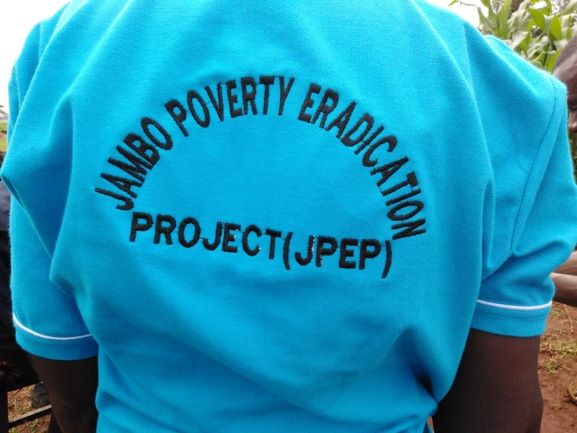
What is JPEP?

JPEP is the third arm of a collaborative partnership between church and community leaders in Western Kenya and Australind Baptist Church, a local congregation in Western Australia. The other two arms are the Anointed Community Academy which provides primary school e ducation in the village of Murari, near Matunda, and two churches under the leadership of pastors Mathews and Henry in Eldoret. Together these three arms form Jambo! And I have the privilege as serving as an honorary Board member and consultant to this group.

The acronym, JPEP represents the Jambo! Poverty Eradication Project and has as its purpose the alleviation of poverty through improved health outcomes and employment opportunities. The communities in which JPEP operates do not have ready access to potable water, appropriate sanitation or reliable power (when it is available at all). Houses often have earth floors and infestation by the Jigger flea or Chigoe parasite which causes Tungiasis, a parasitic condition of humans and animals is rife. Access to schooling is dependent on the ability to travel, purchase resources and uniforms, and pay fees. High levels of unemployment and competing demands on the little money that is available force choices to be made between school and other basic needs.

While financial support is valuable in alleviating short term need, the team behind JPEP understand that this is not the solution they seek. Through cooperative efforts they are seeking to address the health problems faced by the communities, provide employment opportunities and wealth creation through micro-economic  and social enterprise. In doing so they envision a sustainable future in which dignity is restored and dependence on external sources is reduced and ultimately removed.

The conviction of all team members is that evidence of the Kingdom of God is the character of God lived out by the community of God in relationship with the society in which it exists. Justice, mercy and humility are key values which underpin their thinking and planning. The goal is to build the Kingdom of God is built by pursuing the triple bottom line of sustainability – economic, societal and environmental from a Christian worldview.

If you want to know more feel free to message me directly.

Richard Foster

Step up or step out!

Real leadership is always in demand, no more so than when we face adversity or enter uncharted waters. Both of those challenges are present now. Leadership doesn’t only exist at the top of an organisation, but at every level of it and perhaps as much now as ever before we are crying out for leaders to step up.

There are those who will relish the challenge, see an opportunity and commit themselves fully to taking responsibility to meet it. There are others though who will wait for someone or something else to happen. Instead of stepping up, they step out. Often these are the critics, the stone throwers who identify the problems but never see the solutions or at least don’t want to be part of them. The media is full of opinion writers, pundits and ‘experts’ who look for every occasion to find fault, seldom suggesting an alternative and almost never actually producing anything of their own. These people exist too in every organisation.

Real leaders commit to the future, they stay focussed, count the cost but don’t get distracted. They will take initiative and solve problems, they won’t wait to be told what to do and if it is within their remit will just get on and do it. The are others though who will just be missing in action

While we do not want to be going through this current crisis and its tragic consequences, they will reveal who our true leaders are. When we emerge into whatever the future will be these are the leaders to whom you will look to give fresh direction and energy and who give hope when it is most needed.

So just like the rest of us, I have to ask myself the question: Will I step up, or wait for someone else? What about you?

Intended to humiliate not wound

These words were recently used to justify the actions of a young man who broke an egg on the head of an elected senator. The senator had made public remarks that at best were ill advised and inflammatory and were almost universally derided. However, the actions of the young man received both condemnation and congratulation.

In the emotionally charged atmosphere following the tragic events in Christchurch, New Zealand many have attempted to make political mileage and have often used words calculated to score points against their opposition. I don’t want to enter that debate, but I was struck by the justification of this young person’s actions. According to author of the remark wounding only occurs if it is physical, public humiliation does not wound.

It seems to me that the intent of humiliating a person is in fact to wound. Indeed, in almost any other context people would be taken to task for doing just this. Humiliation is intended to bring shame and public opprobrium. It is often much easier to recover from a physical wound than one which creates the loss of self-worth. In many cases this bring long lasting consequences to the person and those who care for him or her.

At a time when social media is full of accounts of those who have been offended at often the most trivial remark, on the basis that it might do damage to their mental health, it seems strange to mount such a claim as this. I am not advocating that we encourage the practice of being offended at nearly everything and using that as an excuse for all sorts of strange claims. In fact my children will confirm that probably all 6 of them have been told on more than one occasion to harden up and get over themselves. I tend toward encouraging resilience rather than removing anything that might challenge their equilibrium. However I am conscious that words can and do cause tremendous harm. They threaten our sense of significance and identity and challenge our sense of worth. This is also true of physical acts that are intended to humiliate.

I do not endorse the views of the senator in question, but neither do I applaud the behaviour of the young man, especially as he was armed with a camera, presumably so that a ‘selfie’ could appear on social media. It wasn’t a spontaneous act, but one that was premeditated and intended to harm. To lionise him and his actions endorses behaviour that is harmful and unacceptable.

Vituperation, Invective or freedom of expression?

Discussion in the public space seems increasingly dominated by forms of expression that are abusive and which would once have been considered highly inappropriate.

Rather than engage intelligently with a person about some issue of difference, at least one party, usually the one with the weakest argument or the laziest approach, just throws an insult, attacks the character of the other person and retreats behind a pseudonym. Of course, the use of abusive language is excused on the basis of freedom of expression.

Many years ago, and I mean decades, I made a decision to stop swearing. It was one of a number of thigs in my life I needed to change and which I believed reflected badly on my character. I no longer swear, I have no need of it. Unless anyone reading this thinks that I am some shrinking violet that has never lived in the real world, let me just set you right. I grew up in a council estate in England, as an adult, among other things I have worked in a maximum security prison, as a chaplain to women seeking to leave prostitution. I have even taught year 11 and 12 students in the Vet system, an environment giving ample opportunity to broaden your vocabulary. I don’t swear because I think it demeans me, adds nothing to the conversation and insults the other person.

Recently a writer, I’m not sure if she is a journalist or claims to be one, resigned from her job in the media because she was asked to moderate her language. She felt unable to do this. It was more important to her to abuse and attack the character of those with whom she disagreed than to engage in a more considered way. Social media (especially Twitter) gives everybody an opportunity to make comment about almost anything. It is a terrific vehicle for engaging, but it is sad that for many it is just a place to launch into an often ill-informed diatribe.

Sadly, the standard of expression marked by invective is characteristic of our parliament, schools, media, leaders in industry, sport and the arts – in fact every arena of life. A standard that is being modelled for our children to emulate, and they do! We all have a choice. If your vocabulary is so limited that you cannot expressive yourself without recourse to abusive language, buy a dictionary. Use language that encourages conversation and builds others up rather than that which is intended to leave them feeling demeaned and hurt. Work at making this a better place not one that is bitter.

You are made for so much more than this

The recent death by suicide of two celebrities, one a designer and the other a chef, together by the decision by a 104 year old professor to end his life has had the media world buzzing with commentary and expressions of regret and sorrow. In some cases, even anger.

In the United States reported death by suicide became the second highest cause of death in the 15 to 34 year old group and 10th overall in 2016. There were a total of 45000 suicides that year. In Australia there were 3000 in 2017, but that is from a population of 25 million. Why has suicide become such a crisis?

Without minimizing the pain and struggle of those who find life intolerable, or even discussing the ethics of prematurely ending one’s life by choice, I suggest there are two fundamental reasons. The first is that for some, life has no meaning or purpose and the second, there is nothing beyond the grave, no eternal state.

The Gospel answers both of those implied questions.

The highest point of God’s creative act is you. Every human being has been made in His image and carries within them the divine imprint of their creator. In Genesis 1:27 God states that He created male and female in His image. Nothing else in all of creation can make that claim, In fact in Psalm 8 the writer asks in wonder “what is so special about mankind that you not only think about them, but you care for them. In fact you have made them superior to all of creation and given them authority over everything!” (my loose paraphrase!).  Back in Genesis he gave further meaning to the life of those he created by telling them to manage the rest of creation, to look after it on His behalf. A job, sadly we have not been particularly good at.

The writer of Psalm 139 states emphatically that God was active in our lives before we drew our first independent breath. So much so that he designed us and put us together exactly the way he wanted to. In Ephesians 2:10 we are told that God had prepared work for us to do even before the world was created. All of life has meaning, no matter how dark and dismal it may seem.

Our life is also valuable. Sadly some people question their worth when they are no longer able to do what they once did, or their relationships fall apart or they lose their job. In fact when any of the many things we use to determine our significance fail us. They may ask, ‘why am I here?’ ‘What’s it all for, why bother?’ What is our value? It may be seen in the affection of others, the contribution to those we have influenced, our place in society, even our success at work or sport or academic achievements. But God puts a much higher standard on your value. Th Cambridge Dictionary states that value is: the importance or worth of something for someone. Your worth to God is measured first of all in the creative activity that made you who you are, but more significantly by the fact that he exchanged the life of His son for yours. He estimates your worth to be that of His son, he was prepared to exchange the life of one for the other.

Your life has meaning, and you are valuable, but you are also unconditionally loved. God loves you so much that he sent His son to die in your place. Now he declares (Romans 8:31-38) that there is absolutely nothing that can separate you from His love, if you have committed to Him in faith. He loves you, he will keep you eternally safe and there is nothing you can do about it!

A number of years ago I conducted the funeral for a 94 year old gentleman. Many years before he had committed murder and served 30 years jail. Now he was in an aged person’s home. At the end of his life on earth he had few friends, was unable to leave his room and lived with his memories. But even there he discovered and received God’s forgiveness and when he died shortly after, he did so with hope and peace. I should add that at the funeral I met a relative who unknown to him, and me, had been praying for him for 30 years!

Victor Frankl was a prisoner during World War II and held in a concentration camp. He was able to discover meaning in the suffering around him and later wrote: “Life retains its meaning under any conditions. It remains meaningful literally up to its last moment, up to one’s last breath.” God has imbued your life with purpose and meaning, he estimates your worth beyond any measure that this world can suggest, and he holds you in the iron grip of His love. You are pretty special!

What of the second issue? Does life continue beyond the grave? The apostle Paul wrote that if we (Christians) live only for this life we are most to be pitied! The writer argued that if there is no God ‘we might as well eat, drink and be merry, for tomorrow we might die’. Why live a life of commitment and sacrifice if there is nothing else? Why bother? Dostoevsky claimed that without God, everything is permissible. Other philosophers argue that it would be unethical not to pursue personal pleasure, because that is the only meaning to life. To deny your self is not only stupid but morally wrong.

The grave is not the end. Eternal life does  not start at the grave either. It begins the moment you and I enter a relationship with God through faith in His son and continues beyond the time that our physical life ends. While we live here we suffer the effects of sin in the world with all of its corruption and suffering, but we wait along with the rest of creation to be set free to obtain the glory of the children of God (Romans 8:27).

You are special. You are created in His image and designed for a purpose. You are the pinnacle of His creative acts, you are of inestimable value and He loves you. You are made for much more than this.

The words of the title of this piece are taken from a song by Mercy Me. Great song, click on the link.

https://youtu.be/Z6pS5HCkgPI


Richard Foster